
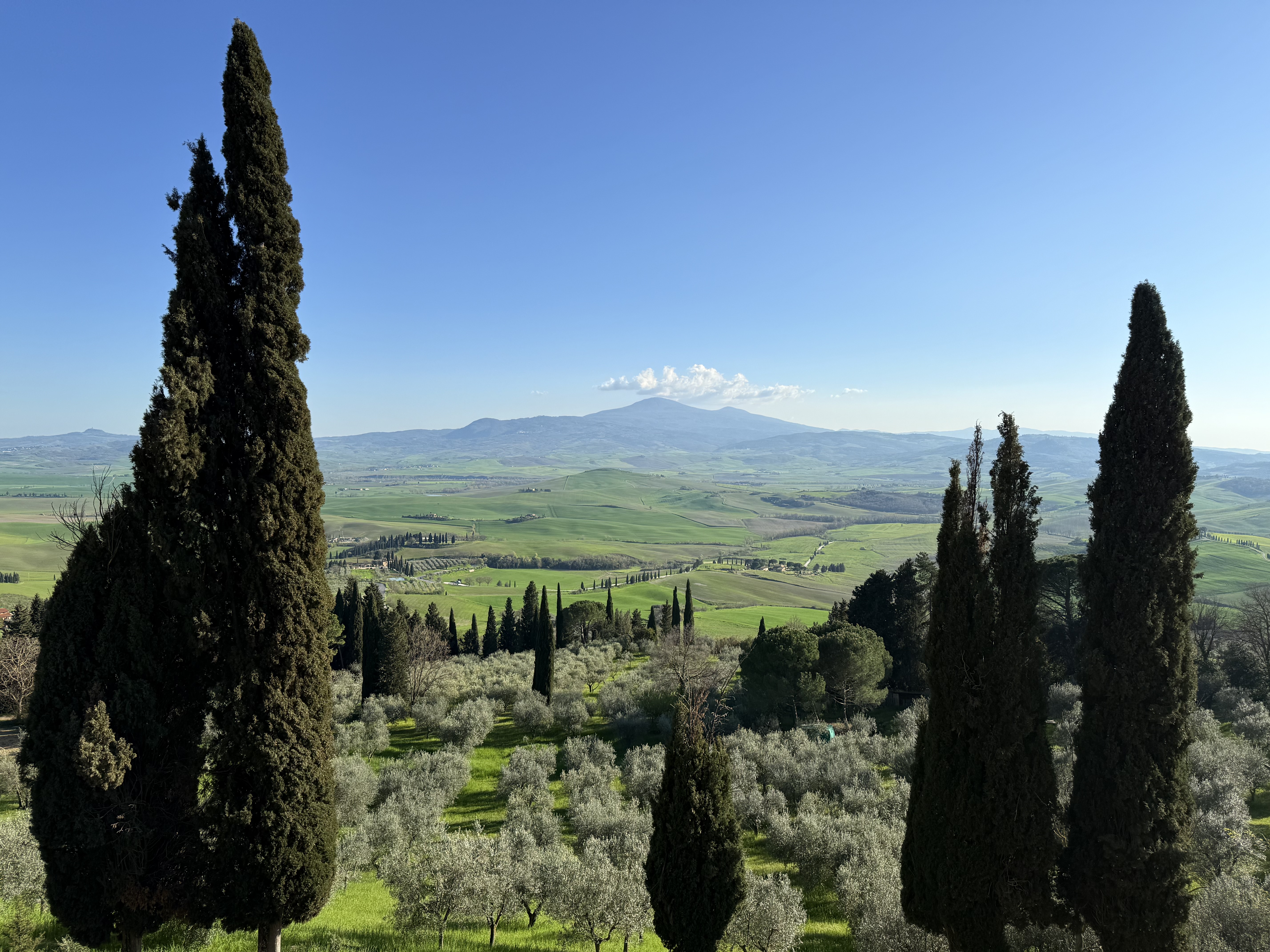
Safari in South Africa, hiking in Hawaii, relaxing in Roatan…what does one do in Tuscany, though? Trekking in Tuscany? Doesn’t seem right. Trying pasta in Tuscany? Too wordy. Tourism in Tuscany? Lol, no. But how about taking it in in Tuscany? Because that’s really what you do there. The sights, the food, the wine, even the sounds of birds in the countryside or the silence of a cool evening…it’s a place where you can experience so many worlds in one. So when we had the chance to jump at Tuscany for a week…well…why not?
Florence
After touching down in Venice, we took an Italo train to Florence, where we’d spend the first night of our trip. The train was comfortable and on-time, delivering us to Firenze Santa Maria Novella station around 5:30 PM. Our first stop was the 25hours Hotel, a boutique-y hotel associated with the Accor group. This was easily the best-themed hotel I’ve been to; its inspiration is Dante’s Inferno, and you can pick a room decorated like heaven (think plush white) or hell (think red, blood, and darkness). A trip to hell seemed like a good way to start a relaxing trip, and we weren’t disappointed with the theming.

The hotel otherwise had lovely staff, a good-looking bar and restaurant, and was most importantly quiet and comfortable for a quick night’s sleep.
We only ended up having an evening and a morning in Florence, so we hit a few of the highlights: sunset at Piazzale Michelangelo, a climb to the top of Giotto’s Bell Tower, a visit to the cathedral, and a stop at Italian McDonald’s (in addition to local restaurants for dinner and lunch–I Guelfi was notable for a great sandwich). Unfortunately, Duomo tickets were sold out — our one real miss in Florence.


Tuscan Countryside
The clear highlight of the trip, the Tuscan countryside is paradise for a relaxing (unless you’re me), wine and food-filled vacation. We picked up a car at the Florence Airport and drove south, bound for Borgo Argiano, where we’d spend the next two nights. One of the nicest things about driving in the region is that you have the ability to park in any tiny town and walk around, eat some gelato and savor the view over the rolling hills. This was exactly the case in Castellina in Chianti, where we found a small fortress offering a nice view of the surrounding region (and an excellent gelato shop just down the street).

The food in the region was incredible, and it started with a beautiful dinner at Chianti Soul Kitchen. The meal started with an amuse bouche (yes, had to Google the spelling as I can probably count on one hand the number of times I’ve been served one) of a cocoa mini pastry with an airy cheese and sun dried tomato and continued with a warm radicchio salad with peanut butter–both of these dishes sounded questionable but were unquestionably delicious. Of course, the buttered pasta and fish with whipped burrata were also delicious, and the service at the restaurant was simply phenomenal; it felt like dining with family.
We spent the entirety of the next day driving around Val d’Orcia, a breathtaking region just south of Siena. Much like driving the PCH, it’s a drive where you can easily stop every ten minutes to marvel at the grandeur of your surroundings. Green hills are dotted with cypress trees, vineyards abut towering mountains, and small towns look as if they’re touching the brilliant blue sky. It’s a spectacular place made even better by the stops along the way; our first was at Caseificio Cugusi, a small cheese shop specializing in packing picnic lunches to enjoy on the grounds. You pick cheeses, jams and meats, and the lovely staff assemble everything into a basket; it was a wonderful way to sample different local products amidst a bucolic setting. After lunch, we continued driving, making several additional stops including Chapel Vitaleta (a lone building surrounded by cypress trees), and the towns of Montepulciano and Pienza before watching the last gasps of a sunset in Siena and heading back to our apartment.


The next day, we’d trade the Chianti region for Serchio Valley, another stunning landscape filled with mountains, rivers, and ground dotted with farmsteads and homes. Before the long drive, we stopped at Poggio Amorelli for a “light” lunch and wine tasting. To not bury the lede, this was the clear highlight of the trip. After a short tour (I learned that many of the barrels used to age wine are from…Canton, Ohio), we settled into a homey dining room overlooking the vineyard and hills. Unfortunately, it was a bit too windy and cool to sit outside–probably the worst weather we had the whole trip (we were incredibly lucky for March). The wine was easily the best I’ve ever tried, the truffle and balsamic oils were spectacular, and the food was plentiful and divine. Our guide Tomazzo was an absolute treat even though his takes on the American fast food system were…flawed (Wendy’s=amazing). We’re anxiously awaiting our shipment of wine (stored sideways so the cork doesn’t dry out) and oils as it makes its way across the Atlantic.
After lunch, we made the drive up to the Serchio Valley for easy(ish) access to…
Cinque Terre
If there was ever an Instagrammable spot, this is it. Small seaside towns perched on steep cliffs with winding streets with shops and restaurants abound. Each village is connected by rail but also by the Blue Trail, a four-section hiking trail covering roughly 10 miles and 3,000 feet of elevation. While it’s also possible to drive between towns, it’s not recommended as the roads are tight and windy and parking is extremely limited. We instead chose to park in La Spezia and take the train to Riomaggiore, the southernmost village and the one closest to La Spezia. We then walked from there to Manarola (paved, accessible path), where we enjoyed lunch at the (too) popular Nessun Dorma, an outdoor-only restaurant serving up bruschetta and aperol spritzes to many a tourist.

We decided to then hike the 4 miles between Manarola and Corniglia. What used to be a 2 mile trek was doubled as part of the trail washed into the sea; the new trail is longer and higher, but offers stunning views of the region and even a short jaunt through Volastra, where you’ll find a couple of (quiet) shops, a church, and some homes. Conveniently, they’ve placed some benches here to take a short break as it’s as the very top of the trek up. It’s a moderate hike with plenty of stairs and some rough terrain, but it’s doable in a pair of well-worn trail runners. After spending some time shopping and eating gelato in Corniglia, we took the train back to La Spezia where we picked up our car and drove back to the hotel. A long, tiring day, but one that won’t soon be forgotten for the beauty along the way.

Conclusion
Tuscany perhaps wasn’t what I expected; it wasn’t a place where my jaw fell to the floor nor one that I can point to three or four points of greatness. Rather, it was a slow burn. It’s a place that builds and builds. It’s the exuberance of a Renaissance city by morning and the deep silence of a charming boutique hotel overlooking miles of rolling hills by nightfall. It’s scenic drives past groves of perfectly maintained cypress trees, stopping for a pinic lunch of local meats and cheeses. It’s meaningful interactions with local restaurateurs and shop owners. Of course, it’s a sip of fine wine and a splash of olive oil, both just yards from where they began in the ground. And finally, it’s reflecting: not all trips are chock full of instant classics, but they don’t need to be. Sometimes, you need a slow burn.
Or…wouldn’t the kids just say that I’m just describing “a vibe”?
Thanks for taking the time to read. Arrivederci!
Leave a Reply